Bling - Video Chat
- 3.1
- Rating
- 10.00M
- Installs
- Free
- Price

 Analysis by App-foxy
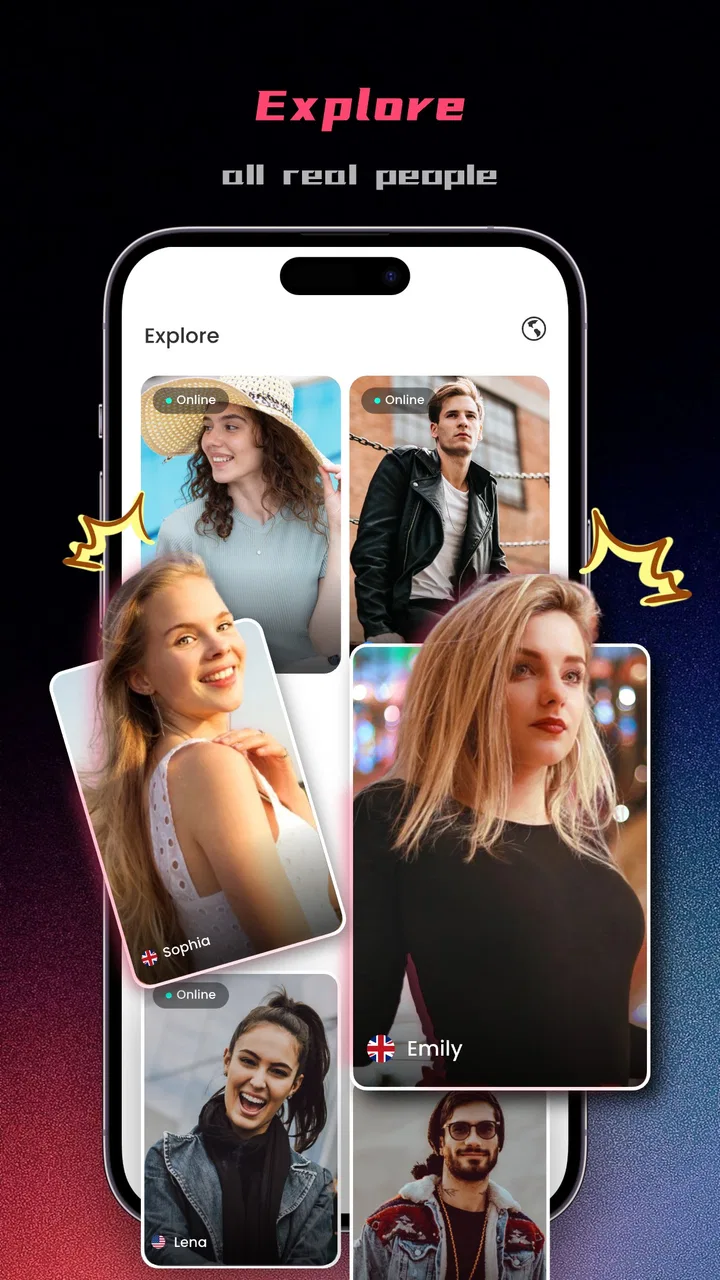
I spent time with Bling - Video Chat as a social app built around meeting people beyond my usual circle, and my first impression was mixed in a useful way. The idea is easy to understand: open a video-focused social space, discover global users, and decide whether a live conversation feels worthwhile. It is less like a carefully organized messaging tool and more like stepping into an unpredictable stream of social encounters.
That difference matters. If you want a quiet place for private conversations with people you already know, this would not be my first recommendation. If you enjoy spontaneous interaction and do not mind filtering through conversations that may not lead anywhere, it has a more relevant appeal. The mature audience positioning also means I would treat it as an adult social environment rather than a general-purpose community app.
The app comes from JHong Technology Limited and is free to install. Its presence is substantial, with over ten million installs, although the average score sits at 3.1 from around eleven thousand ratings. I read that combination as a warning to keep expectations realistic: plenty of people have tried it, but the experience is clearly not equally satisfying for everyone.
You May Also Like

 Blood Strike: 2.5 Anniversary
Blood Strike’s Loadouts Turn Every Drop Into a Tactical Gamble
A close look at Blood Strike’s custom loadouts: how fast access to signature weapons reshapes its battle royale rhythm, rewards preparation, and narrows the gap between fights.

 Pandora - Music & Podcasts
Pandora’s Music Is Easy to Start, but Harder to Recover
Pandora’s strength is its low-effort path from a seed to a station. Its weak spot is how much confidence it asks you to place in connection, setup, and quiet recovery.

 8 Ball Pool
 Is Built on Rivalries, Rematches, and Routine
A close look at the rivalries, rematches, shared routines, and unanswered safety questions that turn a quick pool match into a persistent mobile community.

 Samsung Music
’s Quiet Strength Is Playing What You Already Own
Its reach comes less from spectacle than from dependable access to a personal library. That simplicity is both the app’s strongest retention engine and its ceiling.

 AccuWeather: Weather Radar
AccuWeather Review: A Quick, Clear Forecast for Everyday Decisions
For everyday plans, the best forecast is the one you can understand quickly. AccuWeather makes rain timing, radar, and local conditions easy to act on, with a few trade-offs.

 Hill Climb Racing
Why Hill Climb Racing Still Turns Crashes Into One More Run
A tiny car, a bumpy hill and one more upgrade: Hill Climb Racing keeps resurfacing because its simple chaos makes every near-miss feel personal.
More From Our News Desk
View All News


How Bling - Video Chat feels in everyday use
I find Bling easiest to judge when I treat it as a deliberate social detour, not something to keep open while doing other things. A useful starting point is to decide what kind of conversation I have time and energy for, then stop when that window is over; this keeps spontaneous contact from taking over the rest of my evening. That rhythm also makes personal boundaries easier to maintain.
The first minutes: simple idea, unpredictable pace
The central appeal is immediacy. Rather than spending a long time building a profile or joining a specialized group, I can approach the app with the expectation that social discovery happens quickly. That can make the first session feel lively, but it also means the quality of the experience depends heavily on who is available and how well the interaction matches what I want at that moment.
For example, I can imagine using it after work when I want a short, casual conversation instead of opening a long text thread. In that situation, the app’s video-chat identity is useful because it encourages a more direct form of contact. I would not use it while multitasking, commuting, or trying to concentrate, though. Live social interaction demands attention, and the value drops quickly when I am distracted.
My practical advice is to begin with a short session rather than treating the app as a replacement for every other social platform. Give it a clear purpose: meet someone from a different country, practice casual conversation, or simply see whether spontaneous video interaction suits you. That approach makes it easier to judge the app on its own terms instead of expecting it to behave like a conventional messenger.
Speed expectations depend on more than the app
Video chat always has two layers of speed. There is the time it takes for the interface to respond, and there is the time it takes for another person to appear, answer, or stay engaged. Bling can feel quick when both sides are ready, but no social discovery app can make every human interaction immediate or meaningful.
I would therefore judge its speed by how little friction stands between opening the app and reaching a useful conversation. A fast interface is helpful, but it cannot compensate for pauses, mismatched expectations, or users who leave quickly. If your definition of speed is instant access to a reliable friend, this is the wrong category. If it means getting opportunities for live contact without arranging everything beforehand, the concept makes more sense.
There is also a difference between a brief visit and a long browsing session. During a short check-in, the app’s spontaneous nature can feel efficient. During extended use, repeated decisions about whom to engage with may become tiring. I found that setting a personal stopping point is smarter than endlessly waiting for a perfect conversation to appear.
What happens during heavier use
Video is naturally more demanding than text. A longer session can involve more screen activity, more attention, and greater dependence on a stable connection than a simple chat app. I would avoid assuming that a phone will handle an extended video session identically to a short visit, especially if other apps are already open or the device is older.
My preferred workflow is to close unnecessary apps, connect to a dependable network, and keep the phone comfortably charged before starting. These are ordinary precautions, but they matter more here because a social conversation is difficult to enjoy when I am watching the battery, fighting interruptions, or wondering whether the next delay is caused by the app or the connection.
Another heavy-use issue is mental rather than technical. A stream of unfamiliar interactions can become repetitive if I enter without a goal. I get more from the app when I decide what kind of exchange I am open to and leave when the experience becomes passive scrolling. That is a non-obvious trade-off: the app may offer more possibilities than a small friend list, but more possibilities also require more personal filtering.
Stability and recovering from interruptions
Reliability in a video-social app is not only about whether it opens. It also includes what happens when a conversation ends unexpectedly, when I switch away briefly, or when a connection becomes unstable. I prefer apps that make recovery feel obvious, because live conversations are inherently vulnerable to interruptions.
With Bling, I would approach recovery patiently rather than repeatedly tapping controls. If a session stalls, I would first check the connection, return to the app once, and decide whether restarting the interaction is worth the effort. Repeated attempts can waste more time than simply moving on to another conversation. This is especially important for users with limited patience: the app’s value comes from the quality of the next interaction, not from forcing one particular session to continue.
The rating of 3.1 suggests that the overall experience has not been consistently smooth for the entire audience. I would not interpret that as proof that every session is unreliable, but I would take it seriously when deciding how much time or money to commit. A free app is easier to test, yet free access does not remove the cost of attention, data usage, or frustration.
Older phones and operating-system limits
The listed minimum operating system is Android 7.0, so compatibility starts with relatively established Android devices rather than only the newest models. That does not guarantee identical performance across phones. Camera handling, available memory, background activity, and connection quality can still shape how comfortable video chat feels.
On a modest phone, I would keep expectations conservative. A short conversation may be perfectly manageable, while long sessions could feel less comfortable if the device is already working hard. I would also avoid judging the app during the first seconds after launching several demanding apps, because that creates a poor test of any video service.
For someone using an iPhone, the same general principle applies: the age and condition of the device matter more than the logo on the back. I would keep the operating system current when possible, allow the app to settle before starting a conversation, and avoid using it in places where the network changes constantly. These steps do not transform the service, but they make the result easier to evaluate fairly.
Resource awareness without overpromising
I would describe Bling as an app that deserves ordinary video-chat caution rather than as a lightweight text utility. Camera-based social interaction naturally asks more from a phone than sending messages, and the longer I stay active, the more important battery and connection conditions become.
That is why I would not install it immediately before an important call or use it as my only communication method. For casual exploration, the resource demands are a manageable trade-off. For frequent daily calling, a more established private messenger may be a better fit because I would already know how its contacts, notifications, and conversations behave.
The free entry point helps here. I can try the basic experience without paying upfront and decide whether the social value justifies continued use. Still, the app includes in-app purchases ranging from $0.99 to $199.99 per item. That is a wide range, so I would treat optional spending carefully, especially before I understand which parts of the experience I genuinely use.
Privacy, boundaries, and mature use
The mature 17+ rating changes how I would approach the app. I would not recommend it to younger users, and I would not assume that every conversation will match a family-friendly social network. Adults should enter with clear boundaries, avoid sharing sensitive personal information too quickly, and end conversations that feel uncomfortable rather than trying to be polite.
That advice is not a criticism unique to Bling; it is essential whenever strangers can meet through live video. The video format can create a stronger sense of trust than text, but a face and a voice are not proof that someone is who they claim to be. I would keep early conversations general and move slowly before deciding whether a connection deserves more access to my personal life.
I would also consider where I use it. A private setting is more appropriate than a workplace, classroom, or public transport. Headphones can help with discretion, but they do not solve every privacy concern. The best experience comes from treating spontaneous social contact as something I control, not something I owe to every person who appears.
Who will get the most from it?
Bling is most appealing to adults who enjoy meeting people outside their existing social group and who are comfortable with uncertainty. It may suit someone learning how to start conversations, someone curious about international perspectives, or someone who prefers live contact over long written introductions.
It is also useful for a particular kind of free time: those ten or fifteen minutes when I want human interaction but do not have a specific person to call. In that scenario, the app’s open-ended nature is its strength. I can explore without arranging a meeting days in advance.
I would skip it if I need dependable communication with family, colleagues, or close friends. A dedicated messenger is better when I already know whom I want to reach. I would also choose a specialized community app if my main goal is discussing a hobby, finding local events, or joining structured groups. Bling’s value is the encounter itself, not a clearly defined interest network.
How it compares with familiar alternatives
Compared with ordinary messaging apps, Bling feels more discovery-oriented and less controlled. Traditional messengers are strongest when contact lists, conversation history, and predictable availability matter. Bling is more suitable when I am willing to meet someone new and accept that the result may be brief.
Compared with large social networks, it appears more focused on direct video interaction than on building a broad feed of posts, photos, and public updates. That focus can be refreshing because it reduces the distance between finding someone and speaking with them. The trade-off is that I have less reason to open it when I want news, group discussion, or an organized social archive.
Compared with random video-chat services, the same basic caution applies: novelty can be entertaining, but consistency is harder to guarantee than in a service centered on known contacts. I would choose Bling for exploration, not for reliability-critical conversations. That distinction prevents most disappointment.
Version, cost, and the decision to keep it
The current version is 2.1.2, and the app was released on April 2, 2023. Those details make it a relatively established product rather than something I would treat as a brand-new experiment. Even so, the rating tells me to evaluate the actual experience on my own phone instead of assuming that popularity equals polish.
Because installation is free, my decision would be practical: try it briefly, see whether the available conversations match my expectations, and watch how comfortable the app feels during ordinary use. I would not make an in-app purchase simply because a conversation was disappointing or because I wanted to force a better result. Spending should follow repeated evidence that the app adds value to my routine.
The developer, JHong Technology Limited, has positioned the product in a crowded social space where small differences in stability and user quality matter greatly. For me, the important question is not whether it can produce activity, but whether that activity feels worth my time. A busy experience can still be unhelpful if I leave most sessions feeling drained or disconnected.
My performance verdict
After weighing the speed expectations, heavier-use demands, recovery concerns, and device limitations, I see Bling as a casual social experiment rather than a dependable communication foundation. Its free access and global orientation make it easy to test, while the mature audience and video format require more judgment than a standard chat app.
The best way to use it is deliberately: short sessions, realistic expectations, strong personal boundaries, and no pressure to pay before the free experience proves useful. That approach gives the app a fair chance without ignoring the friction suggested by its middling average score.
I would recommend it to an adult who genuinely enjoys spontaneous video conversations and is happy to filter through uneven encounters. I would not recommend it to someone seeking private, stable, low-effort communication, a structured interest community, or a service that can replace familiar messengers. In my view, Bling has a clear use case, but it is a narrow one: meeting unfamiliar people live when unpredictability is part of the appeal.
For that audience, it is worth trying because there is no upfront price barrier. For everyone else, the usual alternatives are likely to feel calmer, more predictable, and easier on both attention and device resources. The app is at its best when I treat it as an optional doorway to conversation, not as a promise that every opening will lead somewhere worthwhile.
FAQs for Bling - Video Chat
01What is Bling - Video Chat, and how does it work?
Bling - Video Chat is a social communication app designed for meeting and talking with other users through video interactions. After creating an account, you can usually browse available profiles, start conversations, and use in-app messaging or video features. The exact experience may depend on your location, age, account status, and the version of the app installed.
02Is Bling - Video Chat free to download and use?
The app may be available to download at no initial cost, but some features can require in-app purchases, credits, subscriptions, or other paid options. Video calls, virtual gifts, profile visibility, or extended communication tools may not all be included in the free experience. Before spending money, review the pricing details shown in the app store and inside the application.
03Is Bling - Video Chat safe for meeting strangers online?
As with any video chat platform, users should be careful when communicating with people they do not know. Avoid sharing your address, phone number, passwords, financial information, or private images. Use the app’s blocking and reporting tools whenever someone behaves suspiciously or violates the rules. Parents should also check the age rating and supervise younger users where appropriate.
04Does Bling - Video Chat require an account, camera, and microphone access?
Most of the app’s communication features are likely to require an account and permission to use your device’s camera and microphone. These permissions are necessary for live video and audio conversations, while some browsing or messaging functions may work with limited access. You can manage permissions through your Android or iOS settings and revoke them whenever you no longer want to use those features.
05Can I delete my Bling - Video Chat account and report unwanted users?
Before downloading, check whether the app provides account-management, privacy, blocking, and reporting options in its settings or help center. If you encounter spam, harassment, inappropriate content, or suspicious behavior, stop communicating and report the profile through the available tools. Account deletion procedures can vary, so you may need to submit a request or follow instructions provided by the developer.
Pros
- Quick matching makes it easy to start conversations with new people.
- Video calls help create a more personal experience than text-only chats.
- The interface is simple enough for first-time users to navigate.
- Useful for meeting people beyond your usual social circle.
- In-app interactions can feel spontaneous and entertaining.
Cons
- Some matches may be inactive
- awkward
- or uninterested in chatting.
- Video features can use significant mobile data and battery power.
- The quality of conversations depends heavily on the available user pool.
- Privacy concerns may arise when speaking with unknown people on camera.
- Some features or interactions may require purchases or virtual credits.

Bling - Video Chat
Gallery